

CareCrown
Employee recognition & rewards.
Built for home healthcare.
Native Mobile App – B2B SaaS
Industry
Home Healthcare
Role
Co-founder, Lead Product Designer & Product Owner
Caring for the caregiver
“I love the games in the Starbucks app! How can we create this experience for my caregivers?” This was the question posed to me by Elizabeth, the owner of a home healthcare agency in Nashville that employed over 100 caregivers. “I want a system that can motivate and reward my team for their performance, without creating more work for my home office,” she said. This simple idea sparked the creation of CareCrown, a product that would soon be at the forefront of home care innovation.
Professional caregivers work in high-stress, isolated environments with little recognition, while agency owners like Elizabeth struggle with staffing shortages, compliance, and operational overload. The right solution had to motivate caregivers, support administrators, and integrate seamlessly into existing workflows. Sounds easy, right?
It wasn’t. Yet CareCrown emerged from this challenge. I worked directly with caregivers and agency owners to translate game mechanics into meaningful, ethical motivation. Every decision was grounded in one guiding principle: make positive behavior visible, rewarding, and effortless.

Caring for the caregiver
“I love the games in the Starbucks app! How can we create this experience for my caregivers?” This was the question posed to me by Elizabeth, the owner of a home healthcare agency in Nashville that employed over 100 caregivers. “I want a system that can motivate and reward my team for their performance, without creating more work for my home office,” she said. This simple idea sparked the creation of CareCrown, a product that would soon be at the forefront of home care innovation.
Professional caregivers work in high-stress, isolated environments with little recognition, while agency owners like Elizabeth struggle with staffing shortages, compliance, and operational overload. The right solution had to motivate caregivers, support administrators, and integrate seamlessly into existing workflows. Sounds easy, right?
It wasn’t. Yet CareCrown emerged from this challenge. I worked directly with caregivers and agency owners to translate game mechanics into meaningful, ethical motivation. Every decision was grounded in one guiding principle: make positive behavior visible, rewarding, and effortless.

Problem Space & Context
BUSINESS CONTEXT
Home care agencies operate in a labor-constrained environment:
- High caregiver turnover (often 60–80% annually)
- Rising wage pressure
- Increasing compliance requirements (like Electronic Visit Verification)
- Limited tools focused on caregiver motivation and engagement
Existing home care software focuses heavily on operations, leaving a gap in human engagement and behavior change.
USER CONTEXT
Primary users:
- Caregivers (mobile, frontline, time-constrained)
- Agency owners & operations managers (web, metrics-driven)
Key tensions:
- Agencies need reliability and retention
- Caregivers feel undervalued, disconnected, and unrecognized
Core Problems
- Caregivers lacked consistent incentives and recognition
- Agencies had limited levers to influence daily caregiver behavior
- Existing workflows increased reactivity and burnout for office staff
My role
As one of three founders, I served as the sole product leader responsible for designing and delivering CareCrown end-to-end.
I oversaw all aspects of product development, including user research, prototyping, usability testing, UX/UI design, and product strategy. I also served as the product owner, which included managing a fully remote development team, running sprints, overseeing QA, and leading app releases.
Lastly, I leveraged my design background to shape CareCrown’s brand and go-to-market presence by building the company logo, website, and supporting materials.


Design goals
- Increase caregiver engagement and participation
- Encourage on-time clock-ins and completed shifts
- Make recognition feel frequent, fair, and motivating
- Create an experience that caregivers enjoy
- Reduce administrative overhead for agencies
business metrics
- Improved caregiver retention and performance
- Fewer callouts, missed visits, and late clock-ins
- Increased billable hours
- Lower overtime and hiring costs
Constraints
- Caregivers often have low tech tolerance
- Healthcare compliance and data sensitivity
- Must integrate into existing homecare scheduling systems
Discovery & Research
METHODS
-
1:1 interviews with caregivers and agency owners
-
Analysis of attendance, turnover, and compliance patterns
-
Studying trends in the home care industry
-
Competitive analysis of workforce engagement tools
-
Reading Gamify by Brian Burke
KEY INSIGHTS
-
Caregiving is identity-driven. Most caregivers described caregiving as something they were “called to”. Our solution should reinforce purpose, pride, and human impact.
-
Recognition matters, but how it’s done matters more. Client and family recognition is most meaningful, while recognition from the office is valued most when it is personal, specific, and earned.
-
Caregivers respond more to frequent small rewards than to large annual bonuses.
-
Compensation matters, but perceived fairness, appreciation, and stability strongly influence whether caregivers stay.
-
Agencies want behavior change without adding administrative work. Some owners have attempted to manually track and reward behavior, but have given up due to the effort required.
-
Engagement drops sharply if tools feel “corporate” or punitive
OVERALL TAKEAWAY
Caregivers want to feel:
-
Seen (their effort noticed)
-
Trusted (not micromanaged)
-
Respected (clear communication, fair systems)
-
Valued (recognition, growth, reliability rewarded)
When these needs are met, caregivers can tolerate inconveniences, such as scheduling or operational issues. When they aren’t, even the most compassionate caregivers eventually disengage.
”This is not a job that you do for money; you do it because you love it.
Gloria BellCaregiver
”Getting recognition from family members is the most meaningful to me.
Arkeya KnightCaregiver
”I really want caregivers who are doing a good job to know they are appreciated.
Loren BennettScheduling Manager
Our interviews revealed that caregivers are highly purpose-driven. They are most motivated by recognition from clients and families, not by micromanagement or punitive oversight. While pay and scheduling matter, the strongest drivers of satisfaction were feeling seen and appreciated. They want to know that their efforts are noticed.
Many caregivers expressed frustration that positive feedback from families often went undocumented, while recognition from the office was infrequent or impersonal. Caregivers consistently emphasized that knowing they were doing a good job (and having that acknowledged) made them feel more engaged and appreciated.
These findings directly influenced the design of CareCrown as a recognition-first system. One of the most influential findings was that client and family feedback is the most meaningful form of recognition for caregivers. This led to the creation of a rewards system for client feedback, ensuring that praise from families is captured, quantified, and celebrated (rather than lost in phone calls or notes).
To complement this, we introduced a recognition feature called Kudos. A Kudo is a short, personal message from managers to individual caregivers, used to recognize exceptional behavior in the moment. These features make positive performance visible and deliver recognition in a way that feels human, timely, and respectful to caregivers.
Caregiver Challenges

Challenge Details

Kudo Received

Solution Design
CORE SOLUTION
CareCrown is a gamified caregiver engagement platform that rewards positive behaviors such as:
- Consecutive on-time clock-ins (streaks)
- Completing assigned shifts
- Receiving positive client feedback
- Participation in quizzes and training
- Picking up extra shifts
KEY UX COMPONENTS
- A points system tied to objective actions, referred to as Challenges. Earned points can be redeemed for bonus pay or gift cards
- A leaderboard to promote peer competition and social proof motivation
- Badges for tenure and performance achievements
- A Care Quiz to reinforce training and caregiving best practices
- An admin dashboard for agencies to track team performance and issue Kudos


SOLVING THE LEADERBOARD DILEMMA
CareCrown’s leaderboard, which ranks users on points earned, was designed to motivate caregivers through friendly competition and social proof. While this has proven effective for high performers, some agency owners raised concerns that caregivers near the bottom of the rankings might become discouraged and demotivated.
To address this, we implemented two complementary solutions: a monthly reset that gives all caregivers a fresh start each month, and a gated leaderboard that unlocks only after 1,000 points are earned (enough to be well above last place).
This approach preserved the motivational benefits of competition while reducing the risk of demotivation. The gated leaderboard added an element of mystery and served as an additional source of motivation.
AN UNEXPECTED BENEFIT
While performance bonuses provide an immediate and tangible financial incentive, caregivers have cited a deeper, intrinsic benefit: confidence and self-esteem.
Through earning badges, completing challenges, and receiving recognition from supervisors, caregivers gain visible proof of their growth and achievements, something largely absent in frontline care roles.
We realized that CareCrown was providing a pathway for caregivers to measure their progress toward mastery. This led us to prioritize the goal of offering caregivers a lasting sense of accomplishment, professional identity, and pride beyond their paycheck.


DESIGNING MANAGER MODE
CareCrown’s Manager Mode was designed to give agency owners and managers clear visibility into caregiver performance. Many home care leaders reported that their existing scheduling software made it difficult to spot trends, identify top and low performers, or take timely action.
Manager Mode was designed to centralize these critical tasks into a single reporting and management experience, allowing managers to monitor team performance over time, quickly identify outliers, collect and review client feedback, send personalized kudos, and oversee reward redemptions. By translating operational data into actionable insights, Manager Mode enables more proactive, human-centered leadership.
Key Benefits
- Streamlines employee performance reviews with objective, behavior-based data
- Helps managers quickly identify caregivers who may need additional training or support
- Makes it easy to monitor caregiver–client relationships through aggregated client feedback reports
EARLY WARNING SYSTEM FOR CALLOUTS
Last-minute caregiver callouts create significant stress for home care managers. While CareCrown’s attendance incentives help reduce callouts, they can’t eliminate them entirely. This led to a key design question: How might we give managers earlier visibility into potential callouts?
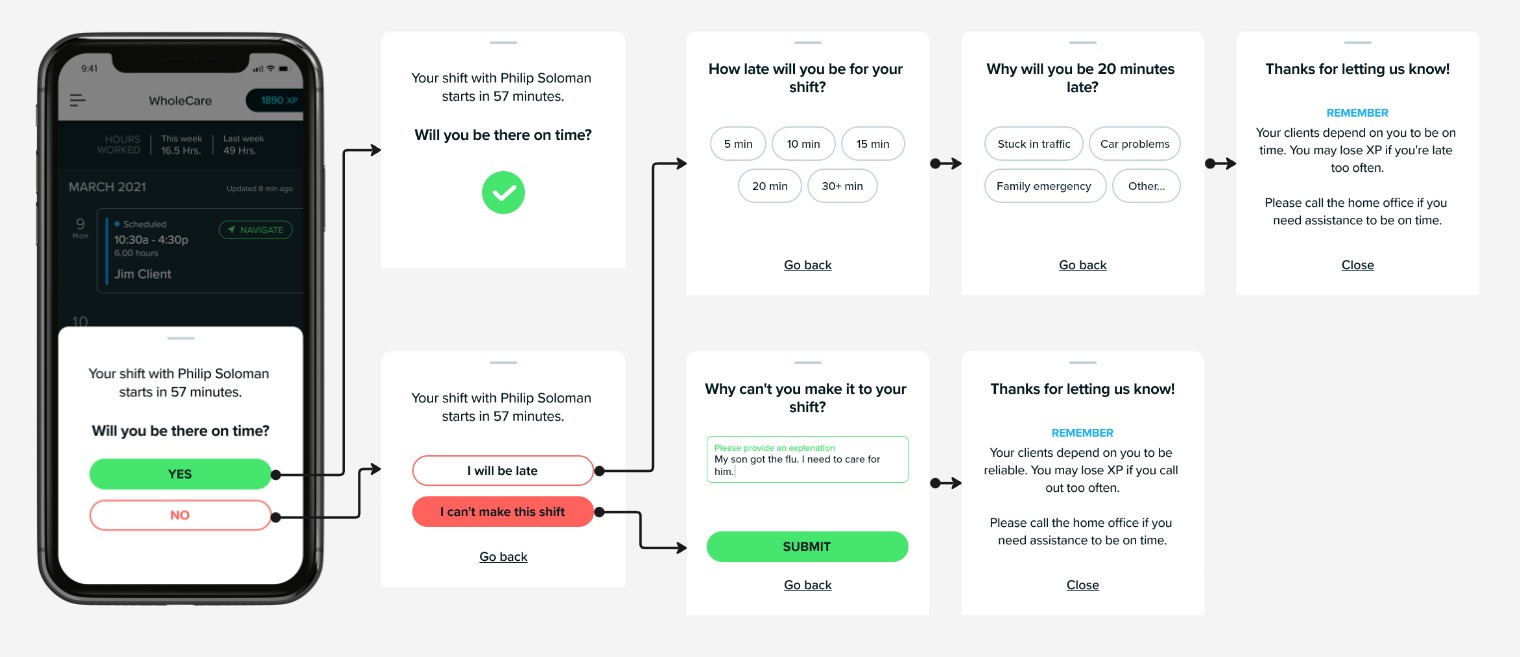
We addressed this with a shift-confirmation feature that prompts caregivers 1 hour before each shift to confirm they’ll be on time. If they confirm, no further action is required. If not, they are guided through a short flow to indicate whether they will be late or miss the shift entirely. When a caregiver reports a delay or absence, managers are immediately notified in Manager Mode, providing valuable lead time to secure coverage.
WHY THIS WORKS
Through manager interviews, we learned that most agencies require caregivers to call the office when they can’t make a shift. However, many caregivers delay or avoid these calls, either forgetting until the last minute or wanting to avoid a potentially uncomfortable conversation. By replacing phone calls with a low-friction, non-confrontational reporting flow and pairing it with a proactive reminder, caregivers were more willing to report issues earlier, giving managers the advance notice they need to act.
”CareCrown is essential for us. It saves my team hours daily by eliminating the need to track down late caregivers—some agencies must hire a full-time employee for this!
Neelima GaikwadOwner, A Place at Home - Schaumburg
”Since we have been using CareCrown, we have seen a dramatic increase in caregiver engagement and overall compliance. The number of shifts needing to be manually verified has significantly decreased, which means our schedulers have more time to do other essential tasks.
Lauren MooreOwner, Hands and Hearts Home Care
”It's a great way to incentivize caregivers to be proactive in clocking in and out independently, which saves me a lot of time not having to track them all down.
Taryn RossStaffing Coordinator, Generations Home Healthcare
”This has been an awesome benefit to our staff. They seem to embrace and find true value in it. They now are more compliant with clocking in and out on time.
Troy HoortOwner, Elders' Helpers
Real customer and caregiver feedback on CareCrown
OUTCOMES & IMPACT
CareCrown launched in the spring of 2022 as a focused MVP and has since evolved into a more mature, scalable product, thanks to the continuous feedback from home care agency owners and their caregivers.
By listening closely to users and iterating quickly, CareCrown has driven meaningful improvements in caregiver punctuality, communication, and overall reliability.
Increased EVV compliance has reduced administrative burden for managers, while fewer callouts and late clock-ins have translated into less revenue lost and higher client satisfaction.
Agency owners consistently report positive caregiver feedback after introducing CareCrown. This momentum has resulted in record-high NPS scores and strong customer retention.
34
%
Improvement in on-time clock-ins
54
%
Increase in EVV compliance
41
%
Improvement in caregiver retention
23
%
Reduction in callouts
2025 METRICS
100
NPS Score - Homecare Operators
480
%
User growth
135
%
Net Revenue Retention
LEARNING & REFLECTIONS
Building and scaling CareCrown reinforced the importance of balancing speed, clarity, and focus in a founder-led product.
One early lesson was the need to provide greater earnings transparency for managers. Specifically, surfacing clear reporting that explained how caregivers earned their points. Without this visibility in Manager Mode, reward redemptions were opaque; managers could see points being redeemed, but they could not see the behaviors or actions that earned them.
This led some of our first customers to question the accuracy and fairness of the rewards program. In hindsight, this transparency was an obvious and essential component for building trust in a system tied to compensation, yet it was overlooked in the sprint to launch the MVP.
We also encountered technical limitations when integrating across multiple third-party scheduling platforms, requiring tradeoffs between ideal UX and feasible implementation.
On the delivery side, managing sprint scope in a fast-moving environment proved challenging; competing priorities occasionally led to scope creep and reduced focus.
Finally, not every feature resonated as expected—some shipped capabilities saw limited adoption, reinforcing the value of earlier validation and stronger kill criteria.
WHAT I’D DO DIFFERENTLY
- Prioritize manager-facing transparency features earlier to build trust and confidence in the rewards system
- Align UX decisions more tightly with integration constraints earlier in the design process
- Enforce stricter sprint scope and clearer “must-have vs. nice-to-have” boundaries
- Validate feature demand earlier and define clear success metrics before building
These lessons continue to shape how I approach trust, prioritization, and delivery in complex, incentive-driven products.

ARTIFACTS
Demo video produced by Tell Strategic Design under Zach’s direction

CareCrown website designed by Zach – www.CareCrownApp.com
Explore More Work
Asurion